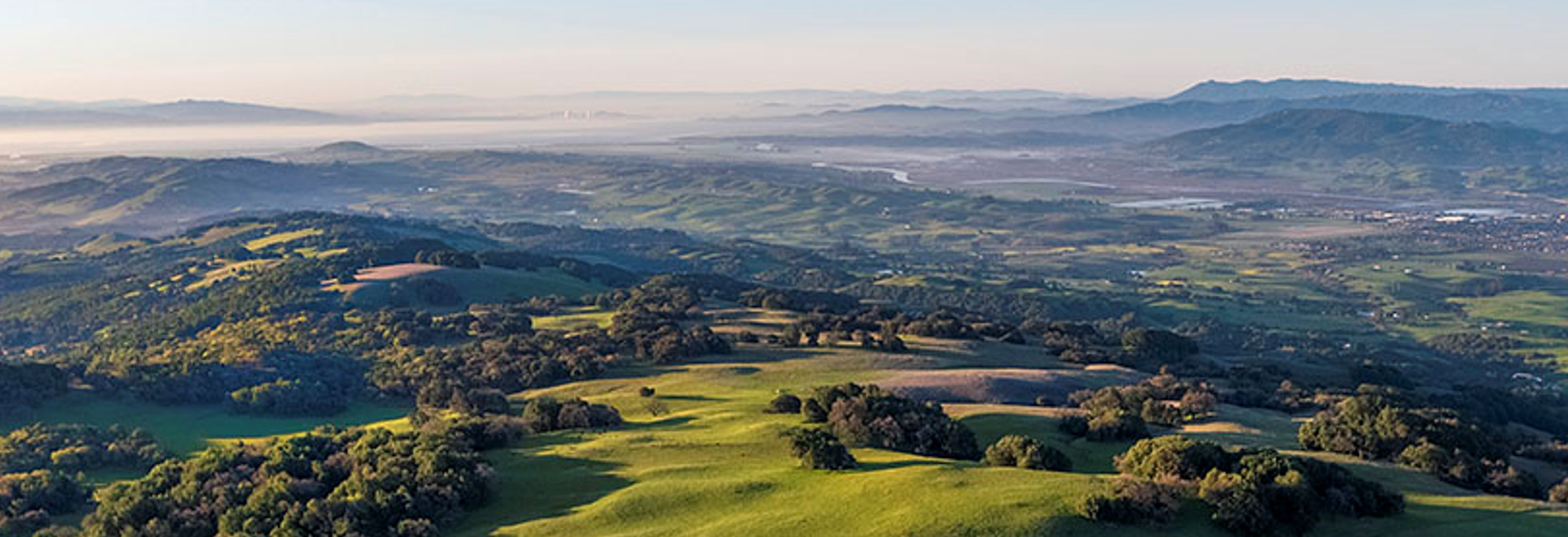
“The air is wine. The grapes on a score of rolling hills are red with autumn flame. Across Sonoma Mountain wisps of sea fog are stealing.”
—Jack London, John Barleycorn (1913)
It’s easy to get lost marveling at the beauty of the Sonoma Mountain landscape and its wild inhabitants; the more domestic elements of the mountain can be neglected for attention. The mountain is also its people, those who visit her and those who live on her slopes, building community and tending to gardens, orchards, and animals. And growing grapes.
As September settles, certain sunny Sonoma Mountain hillsides begin to light up with the autumn colors of vines heavy with ripe fruit. You may see, through your car window, men and women in sunhats loading clumps of green, red, and purple orbs into bins and barrels.
More than a century ago, London was looking at essentially the same early-autumn landscape. Grapevines had been growing on the property that became his Beauty Ranch since around 1860. And the “wisps of sea fog” London watched were more than poetic atmosphere. They were part of a phenomenon that creates a “thermal belt” along the mountain’s slopes, which gives Sonoma Mountain its distinct and favorable grape-growing climate.
At night, cold, dense air drains from the mountain slopes and collects at lower elevations, leaving a “thermal belt” that is relatively warmer than the Sonoma Valley below. During the day, elevation and marine influence help moderate the heat. Together, these mechanisms result in a narrower swing between daytime and nighttime temperatures.
The marine layer that pushes in from the west side of the mountain brings the “sea fog” into the cool air draining downslope toward the valley. Jack London was watching the same interplay of fog, cool air, and topography that, decades later, viticulturists would use to describe Sonoma Mountain’s distinctive climate. Add the mountain’s soils and higher rainfall, and you’ve got grape-growing conditions distinctive enough that, in 1985, the federal government recognized the Sonoma Mountain AVA, Sonoma County’s ninth. An American Viticultural Area, or AVA, designates a grape-growing region with distinct geographic or climatic characteristics. The modern Jack London Vineyard, part of this AVA, sits on a plateau above the fog line, within the landscape whose climate London captured in those “wisps of sea fog.”
The Sonoma Mountain AVA stretches along the mountain’s northeastern slopes, overlooking the Valley of the Moon. It begins around the 400-foot contour and climbs toward the steep terrain at roughly 1,200 to 1,600 feet, though the mountain becomes too rugged for cultivation at much of the higher elevations.
For Sonoma Mountain viticulturists, vineyards are a way of reading the mountain. Where grapes grow, which varieties thrive, when they ripen, where fog reaches, and how slopes face the sun all tell us something about the physical mountain.
More than a century later, September brings grapes toward harvest, fog crosses the mountain, and people still make their lives on its slopes. Wild or cultivated, the mountain shapes all that grows here.

Image courtesy of Jack London State Historic Park